| 1 |
The Knights of Columbus is born on Feb. 6, 1882, when the first mebers choose Columbus as patron. |
 |
| 2 |
“Charity” and “Unity” are chosen as the Order's founding principles; “Fraternity” is added in 1885 and “Patriotism” in 1900. |
|
| 3 |
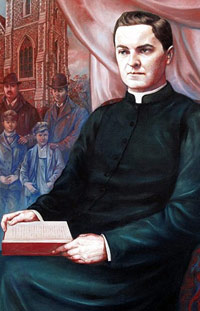
Father Michael J. McGivney's name is listed first among the insured members of the Order in a record book dating back to the founding. |
|
| 4 |
Immediately after the Order's March 29, 1882 incorporation, Father McGivney sends the first diocesan-wide appeal for new members to his fellow priests. |
|
| 5 |
A celebratory parade and clambake held Aug.12, 1885 in New Haven, draws a reported 12,000 Knights and supporters. |
|
| 6 |
During his four-year tenure as supreme knight from 1882-86, James Mullen presides personally at the institution of 22 of the first 38 councils. |
|
| 7 |
The Order's first headquarters is one room located on the second floor of a three-story building next to New Haven's City Hall. |
|
| 8 |
In 1889, the Order's Board of Government (Supreme Council) votes to pay $1,000 to Father McGivney “in gratitude” for his services in establishing and promoting the Knights. |
|
| 9 |
John J. Phelan is elected supreme knight (1886-97) and is the first leader to sense the Order's destiny as a national society. |
|
| 10 |
Father McGivney dies on Aug.14, 1890. His funeral Mass is celebrated in Thomaston, Conn., on Aug.18. |
|
| 11 |
In 1892, the Order passes laws allowing noninsurance or associate members to join.. |
|
| 12 |
In November 1893, The Columbiad, a forerunner to Columbia, begins publishing. Its editor, Thomas A. Cummings, is also the Order's first national director of ceremonials. |
|
| 13 |
Ladies' auxiliaries begin to emerge in the late 1890s. |
|
| 14 |
6,000 Knights march in an 1892 Columbus Day parade in New Haven; nearly 40,000 people attend |
|
| 15 |
The Vatican's first acknowledgement of the Knights comes in 1895, when Archbishop Francesco Satolli, apostolic delegate to the United States writes a letter extolling the “merits of this splendid Catholic organization” and giving the Order his apostolic blessing. |
|
| 16 |
James E. Hayes, the Order's third supreme knight (1897-98), joins the Knights in Massachusetts in 1892; during his tenure as a district deputy and state deputy, he presides over the institution of 75 councils. |
|
| 17 |
John J. Cone succeeds Hayes and serves from 1898-99; he is a member for less than three years when he is elected supreme knight.
|
|
| 18 |
Under Cone's leadership, the Knights subscribe to war bonds to support the Spanish-American War; at his direction, soldiers and sailors are not disqualified from being insurance members. |
|
| 19 |
On Nov.25, 1897, Canada's first council – Montreal Council 284 – is chartered. By 1905, the Order is established in every U.S. state, five Canadian provinces, Mexico, the Philippines and is soon to enter Puerto Rico and Cuba. |
|
| 20 |
Writing in the The Columbiad in 1898, a year before he was elected supreme knight, Edward L. Hearn says a Knight should live according to the virtues of loyalty, charity, courtesy and modesty, “self- denial and a careful respect for the feelings of others.” |
|
| 21 |
Hearn's administration modernizes the Order's insurance program, employing mortality tables and other tools of commercial insurers. |
|
| 22 |
The first exemplification of the Fourth Degree takes place on Feb.22, 1900 in New York City; 1,100 Knights receive the degree. The following May, another 750 Knights take the degree in Boston. |
|
| 23 |
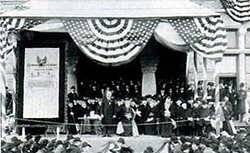
On April 13, 1904, more than 10,000 Knights and their families attend ceremonies at The Catholic University of America (CUA) in Washington, D.C., in which a check for $55,633.79 is presented to the school for the establishment of a K of C chair of American history. From 1909 to 1913, Knights raise $500,000 to establish a permanent endowment for CUA.
|
| |
|
|
| 24 |
A reported 5,000 Knights meet James A. Flaherty's train in Philadelphia in 1909, when he arrives at the annual convention where he is elected supreme knight. |
|
| 25 |
In 1912, with support from the Knights, the Columbus Memorial Fontain is dedicated in Washington, D.C. Some 20,000 Knights attend the ceremonies. |
|