| 26 |
A reporter for the Washington Star notes that the large number ok Knights in attendance "marked a new the important position of Knights of Columbus as an oder in the social fabric of the United States." |
 |
| 27 |
Tens of thousands of copies of a “bogus oath” are circulated to defame the Knights of Columbus. In 1914, the Knights lay the groundwork for a lecture series and educational programs to combat anti-Catholic hostility. |
|
| 28 |
Between August 1914, when the Order's Commission on Religious Prejudice is established, and January 1917, when it is dissolved, the number of anti-Catholic publications drops from 60 to fewer than five. . |
|
| 29 |
When National Guardsmen are sent to the U.S.-Mexico border in 1916 to prevent Mexican Gen. Francisco “Pancho” Villa from raiding towns in New Mexico, Arizona and Texas, Knights of Columbus councils in those states spontaneously respond to the religious and social needs of troops serving there. . |
|
| 30 |
When the United States enters World War I in 1917, Supreme Knight Flaherty writes President Woodrow Wilson telling him that the Order plans to establish centers to provide for the troops' “recreational and spiritual comfort.” The Knights' services, he says, will be offered “regardless of creed.” |
|
| 31 |
By the summer of 1917, the Order's War Activities Committee is fully operational. The Order opens service centers or “K of C Huts” in training camps and behind the lines of battle. The Knights and independent fund drives raise nearly $30 million to finance the huts. |
|
| 32 |
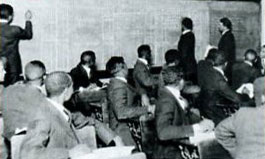
At the conclusion of World War I, the Order starts educational, vocational and employment programs for veterans. In 1920, more than 50,000 students are enrolled in evening school programs across the United States and Canada.
 |
|
| 33 |
A correspondence school is also started to help veterans. More than 25,000 enroll, and the Order awards more than 400 scholarships to veterans. |
|
| 34 |
As a result of the Order's wartime work, nearly 400,000 men join the Knights between 1917 and 1923. |
|
| 35 |
In August 1920, 235 Knights sail from New York City to France. In Paris, they are greeted by Church and civic authorities who thank the Knights for their WWI work. In Metz, a large equestrian statue of the French patriot Lafayette, funded by the Knights, is unveiled. The statue celebrates Lafayette's defense of American liberty during the Revolutionary War, and the “glorious dead of the American and French armies.” |
|
| 36 |
The K of C delegation continues to Rome, where it is received in a private audience with Pope Benedict XV on Aug. 28.Supreme Knight Flaherty tells the pope that the ideals of the Knights are “wrapped up in the well-being of the Church.” He also remarks that the Knights “claim kindred with you” and pledges the Order's “love and support and all the energy of our Catholic manhood.” |
|
| 37 |
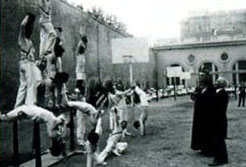
In response to a request from Pope Benedict, the Knights opens St. Peter's Oratory, the first of five K of C recreation centers for youth in Rome established between 1924 and 1927.
 |
|
| 38 |
The Order's anti-defamation work resumes after World War I. The K of C Historical Commission publishes the Knights of Columbus Racial Contributions Series in 1924.Three monographs dealing with the positive contributions of blacks, Jews and Germans to American society are published. |
|
| 39 |
The Knights' Rome youth work stimulates interest in similar projects elsewhere, and the Columbian Squires program is established. Brother Barnabas McDonald, a Christian Brother who had gained renown for his work with delinquents and orphans, consults with the Knights on the creation of the Squires. . |
|
| 40 |
In 1924, the University of Notre Dame starts a two-year graduate-level program in Boy Guidance to train Knights and others in working with young men. Notre Dame football great Knute Rockne is among the instructors. |
|
| 41 |
The institution of the first Columbian Squires circle takes place at the Supreme Council meeting in Duluth, Minn., in August 1925. |
|
| 42 |
In response to the passage of laws in Oregon in 1923 prohibiting children under 16 from attending private schools, the Knights work to overturn the law. In 1925, the Supreme Court declares the Oregon law unconstitutional. |
|
| 43 |
In September 1926, Supreme Knight Flaherty, Deputy Supreme Knight Martin H. Carmody and other officers meet with U.S. President Calvin Coolidge about the persecution of the Catholic Church in Mexico. |
|
| 44 |
The Order launches a $1 million educational campaign to influence American public opinion on the need for a strong stand against the Mexican government's attacks on the Church. |
|
| 45 |
More than 5 million copies of various pamphlets with eyewitness reports on Church persecution in Mexico are printed and distributed by the Order. |
|
| 46 |
In 1934-35, the Order drafts a resolution for the U.S. Senate calling for an investigation into the persecution; it is defeated. |
|
| 47 |
On July 8, 1935, Supreme Knight Carmody and other K of C officials meet with President Franklin D. Roosevelt about the situation in Mexico. By mid-1937, tensions ease between the Mexican government and the Church. |
|
| 48 |
The 50th anniversary of the Knights is celebrated with Commemoration Week, June 24-30, 1932. Among the highlights is the unveiling in Washington, D.C. of a statue of Cardinal James Gibbons, an early supporter of the Knights who had also ordained Father McGivney. |
|
| 49 |
More than 400 councils stage a one-act play on the founding of the Knights during Commemoration Week. |
|
| 50 |
In January 1936, the “Five-Point Program of Progress” is launched. Its aim is to provide councils with a framework for their activities. The five categories are: Catholic Activity, Council Activity, Fraternal Protection, Publicity and Maintenance of Manpower. |
|