| 51 |
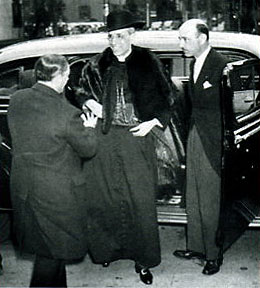
Eugenio Cardinal Pacelli, Vatican secretary of state, visits the Knights of Columbus headquarters in New Haven in 1936; in 1939, Cardinal Pacelli becomes Pope Pius XII.
 |
 |
| 52 |
In response to Pope Pius XII's petition for prayers for peace, the Knights of Columbus sponsors an international prayer-for-peace program on Armistice Day, 1939. Canadian Knights establish a welfare program for soldiers comparable to the KC huts program that operated during World War I. |
|
| 53 |
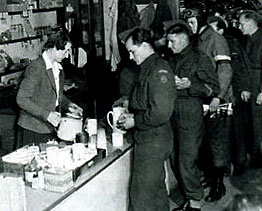
On Sept. 13, 1939, less than two weeks after war was declared, Canadian Knights establish a welfare program for soldiers comparable to the KC huts program that operated during World War I.
 |
|
| 54 |
Between December 1939 and April 1940, Canadian Knights raise nearly $250,000 to support troops. When the U.S. enters the war in 1941, the Order's outreach to soldiers is conducted via the National Catholic Community Service organization. The NCCS models many of its programs on the Order's successful WWI efforts. |
|
| 55 |
John E. Swift is elected supreme knight in 1945. Among his first initiatives is to authorize funding for full-page advertisements in 12 major U.S. newspapers and five Canadian papers highlighting the dangers of communism. The ad offers a free copy of Msgr. Fulton J. Sheen's pamphlet, “Communism, the Opium of the People.” |
|
| 56 |
The Order creates a $1 million trust fund for the education of children of members who had died in World War II. This evolves into the current scholarship fund for use at Catholic colleges and universities in the U.S. and Canada. |
|
| 57 |
In December 1946, the Order launches its Crusade for the Preservation and Promotion of American Ideals. Educational pamphlets on communism and the dangers of secularism are published and distributed; councils set up groups where the pamphlets are discussed. By August 1948, there are more than 1,300. K of C discussion groups, college students and seminarians are enlisted as “lay apostles” in the Knights' efforts. |
|
| 58 |
In 1947, several hundred radio stations broadcast K of C- sponsored programs with the titles “Safeguards of America” and “Foundations of Our American Ideals.” A 1948 series is entitled “The Future of America.” |
|
| 59 |
Luke E. Hart becomes supreme knight in 1953; he is the first supreme knight to move to New Haven to assume his duties, reflecting the development of the Knights as a corporation. |
|
| 60 |
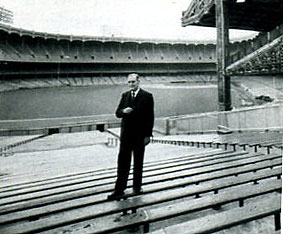
On Dec. 17, 1953, the Knights of Columbus purchases for $2.5 million the land on which Yankee Stadium is built. When news breaks of the Knights' acquisition, councils and members send congratulatory telegrams to New Haven.
 |
|
| 61 |
A Catholic advertising program launched by Missouri Knights in the 1940s is adopted nationally by the Order during Hart's administration. The ads encourage readers to learn more about Catholic teaching by contacting the Religious Information Bureau, later the Catholic Information Service. |
|
| 62 |
In April 1951, the Order votes to fund the microfilming of irreplaceable documents from the Vatican Library, some dating to the pre-Christian era. The library at St. Louis University is named as the repository for the Knights of Columbus Vatican Film Library at St. Louis University; 9.5 million manuscript pages have been microfilmed and made available for scholars. |
|
| 63 |
From 1951 to 1954, the Order spearheads efforts to place the words “under God” in the U.S. Pledge of Allegiance. On June 14, 1954, Flag Day, President Dwight D. Eisenhower signs it into law. |
|
| 64 |
On May 10, 1959, Pope John XXIII becomes the first pope to visit a K of C playground in Rome. |
|
| 65 |
On Nov. 20, 1959 the National Shrine of the Immaculate Conception in Washington, D.C., is dedicated with more than 1,000 Knights forming the honor guard. Knights contributed $1 million, via a $1.25 per-capita assessment over five years, for construction of the 329-foot bell tower. |
|
| 66 |
In 1963, the Order finances installation of the carillon of 56 bells at the National Shrine. |
|
| 67 |
On Oct. 11, 1961, Supreme Knight Hart visits President John F. Kennedy in the White House. Kennedy, a Fourth Degree Knight, reportedly greets Hart by saying, “Hello, Chief.” |
|
| 68 |
In the spring of 1963, Hart attends a special White House meeting of religious leaders to discuss civil rights. |
|
| 69 |
Supreme Knight John W. McDevitt takes office in 1964. His first priority is amending the Order's admission policies to counter charges of racial discrimination. |
|
| 70 |
In April 1965, the Order co-sponsors with the Archdiocese of Hartford a Conference on Human Rights at Yale University in New Haven. More than 2,000 people attend the conference on interracial justice. |
|
| 71 |
At the Supreme Council meetings of 1965 and 1966, McDevitt addresses how the Knights will respond to the Second Vatican Council and its call for renewal and reform within the Church and its organizations. The Knights, he says, will be “characterized by respect, reverence and relevance” and a “dynamism which is willing to adapt, to explore and to act.” |
|
| 72 |
In 1967, the Order collaborates with the John LaFarge Institute in New York City on programs to promote social justice and ecumenical outreach. Jesuit Father John LaFarge was a leader of the Catholic interracial movement. |
|
| 73 |
The Knights provides funding for CARA, the Center for Applied Research in the Apostolate, which, since its founding in 1964, has conducted social scientific studies on the Church. |
|
| 74 |
On June 30, 1966, Supreme Knight McDevitt visits the Vatican Transmitting Center for the blessing of a new shortwave radio transmitter donated by the Knights. Pope Paul VI blesses the transmitter. |
|
| 75 |
The present Supreme Council headquarters is completed in 1969.Its four 320- foot towers symbolize the Knights' four ideals of Charity, Unity, Fraternity and Patriotism. |
|